Below are two pictures of the same product. The first one did not exist as a physical object when it was made. The second one is lying on a table in our workshop right now.
Between them there is a text prompt, about thirty minutes, and then a lot longer than thirty minutes of the ordinary factory work that AI cannot do: choosing fabric, burning screens, matching the gold, sewing the drawstring channel.
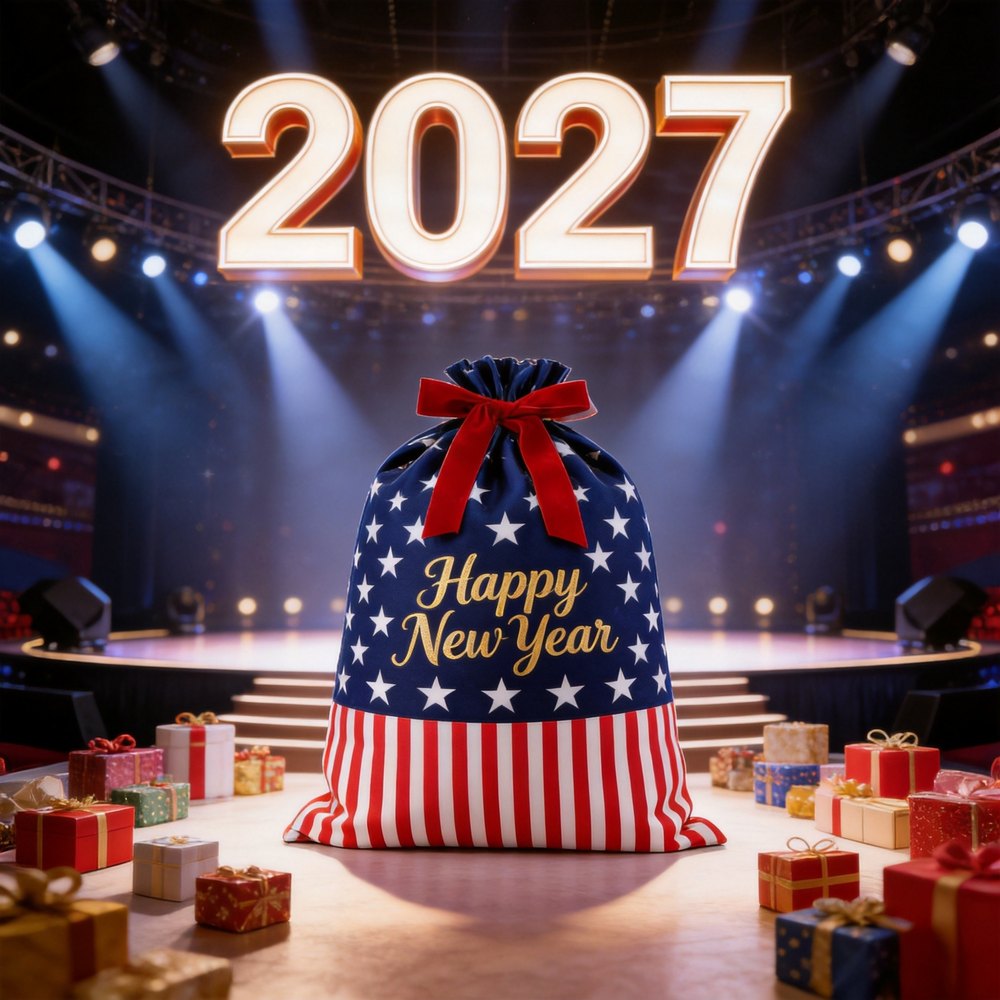
The mockup. No sketch, no designer, no sample. Roughly thirty minutes.
This is the part of AI that has actually changed my job. Not "AI writes my emails". AI collapsed the distance between an idea and a picture of the idea. For a factory, that distance used to be measured in days and sample fees.
What It Used to Take to Show a Customer an Idea
Before this, when a buyer said "I want a New Year drawstring bag, stars and stripes, gold lettering", here is what happened:
- I ask ten questions about size, fabric, quantity and printing method.
- I dig through last season's samples and photos of similar jobs.
- I send something that is close, and say "like this, but blue, and with stars".
- The buyer asks "can you show me?"
- I say "I'll have our guy draw it" — which means waiting, and often means a rough Photoshop job anyway.
Sometimes the honest answer was a real sample. That costs about a week and a sample fee. Most of the time, though, the customer was asked to imagine it. Some buyers are good at that. Most are not — and I don't blame them, because neither am I, working from a paragraph of text.
Thirty Minutes, Start to Finish
The prompt that produced the image above was not "a New Year bag". That gets you something generic and useless. What worked was describing it the way I would describe it to my own sample room:
- The object: drawstring gift pouch, soft body, fabric rather than paper.
- The layout: navy blue upper field, white stars scattered but evenly, red and white vertical stripes along the bottom third.
- The lettering: "Happy New Year", gold, script, centred on the navy field.
- The finish: gold that reads as metal, not as yellow.
- The setting: a stage with "2027" behind it, gift boxes around the base.
Version one came back beautiful and wrong: the stars were random sizes, the gold glowed like a light bulb, and the bag bulged as if it were stuffed with pillows. Version two was closer. Version three is the image at the top of this page.
From opening the tool to a picture I was willing to put in front of a buyer: about half an hour. I have spent longer than that looking for a reference photo.
Where the Render Lied
This is the part nobody posts about. A generated image is a proposal, not a production drawing. Five things had to change between the picture and the bag.
1. The stars
AI scattered the stars in slightly different sizes, which looks natural and costs money. In screen printing, every star size and position is a decision — irregular placement means more screen work and more setup. On the real bag the stars follow one repeatable template with even spacing. Slightly less "designed", far more buildable.
2. The gold
In the render, the gold is emissive. It glows. Fabric does not glow. A real metallic gold comes from either metallic ink or foil, and that choice changes the unit price and the lead time. It is exactly the kind of decision AI cannot make for you, because the answer depends on your quantity and your deadline, not on how the picture should look.
3. The shape
The render shows a bag full of presents — which is how a gift bag is used, not how it is manufactured. Laid flat, the same bag is a rectangle with a seam. Whether it stands up when filled depends on fabric weight and base construction, and no amount of prompting tells you that.
4. The drawstring
AI drew a red ribbon tied in a bow. Pretty. But a drawstring bag needs a channel wide enough for the cord, an opening for the cord to exit, and a cord that survives being pulled a few hundred times. The real bag has a proper drawstring channel; the bow became an optional decoration rather than a structural element.
5. The stripe count
What reads as "stripes" at 1080 pixels becomes a specific number of stripes at 40 cm. Stretch or shrink the design and the count changes — which changes how the bottom of the bag reads from three metres away, the distance that actually matters on a shelf.
None of this is an argument against using AI. It is an argument against treating the render as the spec. The image decides what we aim for. The sample room decides what we ship.
The Bag: 2027 New Year Stars & Stripes Drawstring Bag
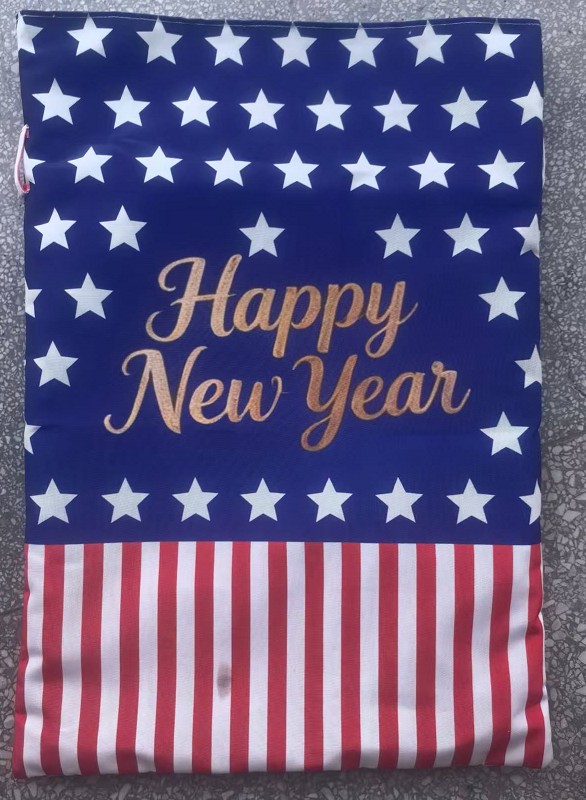
The actual sample. Navy field, white stars, gold "Happy New Year", red and white stripes, drawstring top.
What we ended up with:
- Body: navy field with white stars across the upper two thirds.
- Base: red and white vertical stripes along the bottom — the part that reads as "celebration" from a distance.
- Front: "Happy New Year" in gold script. Can be swapped for "2027", a brand name, or a logo.
- Top: drawstring closure, so the bag shuts without tape or ribbon.
- Use: New Year gifts, countdown parties, staff gifts, corporate New Year sets, and a seasonal SKU for sellers on Etsy, Amazon and TikTok Shop.
It is on our holiday products page now, next to the Christmas range.
What can change without starting over: the colours (navy and red is a reference, not a rule), the gold to silver or white, the lettering, the size, the fabric, and the printing method. What cannot change for free: the number of colours, because every colour is a screen or a pass.
What the Half Hour Actually Buys You
I want to be precise about the claim, because "AI designs products in 30 minutes" is the kind of sentence that makes factory people roll their eyes — and they are right to.
The half hour does not produce a bag. Sampling still takes about a week, and bulk production takes as long as it takes. What the half hour removes is the back-and-forth before anyone commits: the "can you show me", the rough sketch, the buyer who cannot picture it, the two weeks lost agreeing on what the thing looks like.
It also changes the quality of the conversation. When a buyer can see the bag, the next questions become useful ones — "can the stars be smaller", "what if the stripes were gold" — instead of "I'll think about it".
"AI is fast at the part that used to be slow. It is not fast at the part that used to be hard."
Which is roughly where we landed with the Christmas bags last week: the design was never the bottleneck. Packing was. Same lesson, different month.
Want One With Your Logo?
Send me a description — or a generated image, I genuinely do not mind which — and I will tell you what it costs to make it real, and what has to change to get there. MOQ starts at 100 pieces, samples take about 7 days.
Get a quote · Try our online bag designer · See the holiday range