Every workshop has one piece it uses as a ruler. When a new buyer asks how good our work really is, we don't send a catalogue — we send the object that took the most out of us. For the last few years, that object has been a cake box.
Not a cake box in the cardboard sense. A rigid, leather-wrapped case built like a slice of cake: an arched crown, a strap and buckle laid over the top, botanical line work foiled across the shell. Lift the crown and the two halves open like a book. One side is a stack of three drawers in butter-yellow suede, each with a slim gold pull. The base slides out as a tray with ring rolls and necklace channels. The other half falls open flat, lined, waiting for earrings.
Closed, it is dessert packaging. Open, it is a dressing table that fits in two hands.
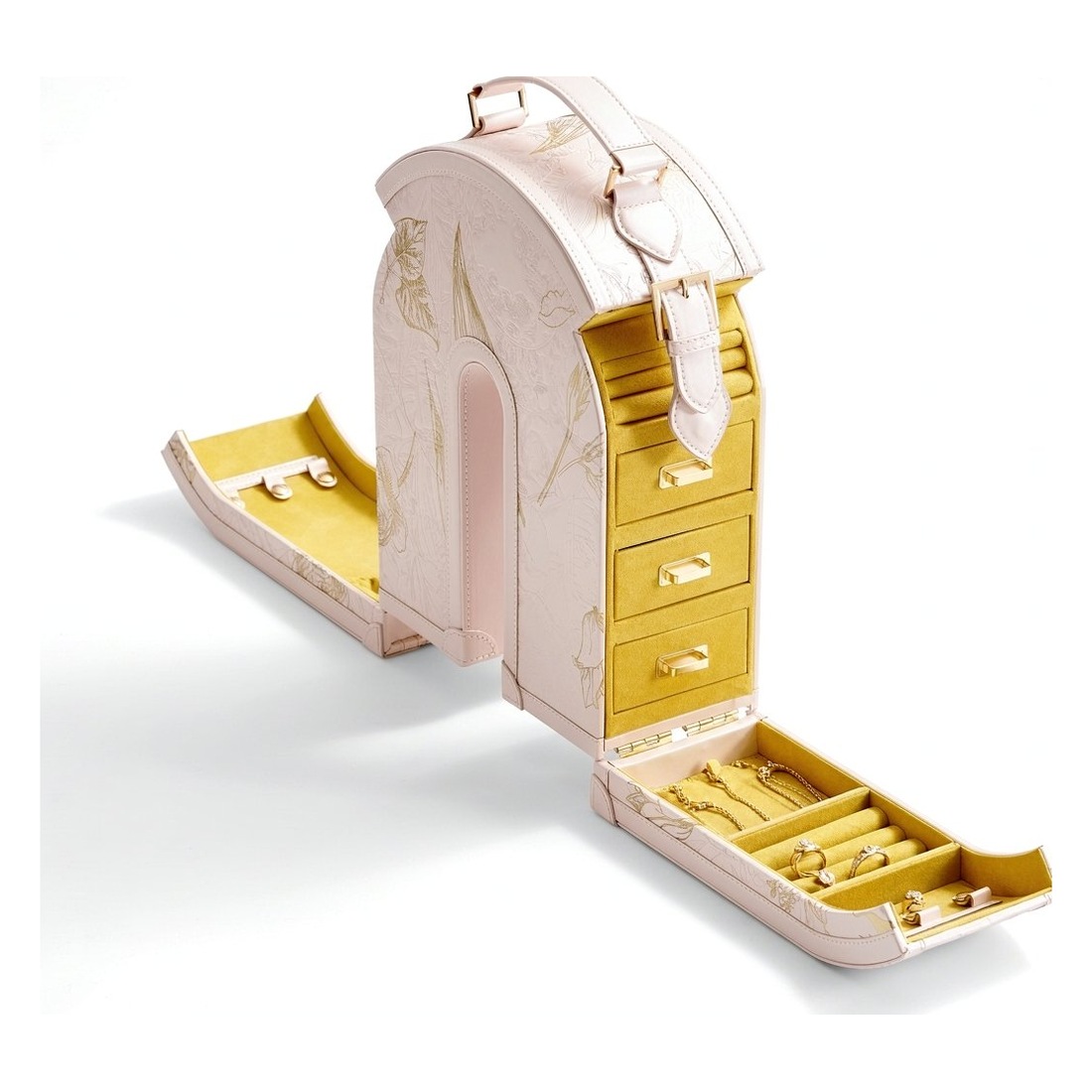
The finished piece: arched shell, batwing strap, three suede drawers, ring tray.
It is, without argument, the most precise thing we have made in twenty years of bags. It is also the only sample we have ever paid around ¥2,500 to develop — roughly US$350 for a single unit. The enquiry behind it was 100,000 pieces, which is the only sane reason to spend ¥2,500 on one.
(normal bag: ¥300–800)
original enquiry
at that volume
pull-out ring tray
Why a Sample Costs ¥2,500
Buyers are used to sample fees in the low hundreds of RMB, and they are right to expect that. Bags are forgiving objects. Fabric bends. A seam can be eased. If a panel runs 2 mm long, the bag still closes, still sells, and nobody ever knows.
This box forgives nothing. Four reasons, and they are the whole project.
1. It is a box pretending to be a bag
Under the leather there is a board skeleton: base, side walls, an arched crown, a hinged spine. That arch curves in two directions at once — a compound curve, which is the shape leather resists most. Each panel has to be cut on its own pattern, skived thin at the edges, glued, stretched and dried on a form before anything is assembled. Pull too hard and the pearlescent finish crazes; pull too little and you get a wrinkle at the shoulder that no amount of heat will take out.
On a tote, a wrinkle is a wrinkle. On a pearl-finished shell under studio light, it is the first thing anyone sees.
2. The drawers have to actually slide
A drawer that sticks is not a cosmetic defect — it is a returned product, and the customer will never trust the box again.
Clearance is measured in fractions of a millimetre, and the number moves: board thickness, suede thickness, glue film, workshop humidity, and the fact that a rigid box swells and settles after it has travelled in a container. We had to build the openings slightly generous, then line the runners so the drawers still glide six months later instead of rattling on day one. That is a tolerance problem, not a sewing problem, and it is why this product needed a real pattern maker rather than a sample hand.
3. The suede lining gives you one attempt
This is the operation that eats the money. Suede records everything — every glue smear, every needle hole, every finger mark. On a fabric bag you can unpick a seam and re-stitch it. Here, one misplaced stitch line and the panel is scrap, and the panel already had an hour of wrapping in it.
Each compartment is lined as a single piece, turned and glued into corners that have no room for a fold. The inside of a drawer is the hardest surface on the whole object, and it is also the surface a customer touches first.
4. The pattern has to stay registered across a curve
The botanical motif is not a sticker applied at the end. It runs from the flat face, over the arch, and into the side panel — and the eye is brutally good at catching a motif that jumps 2 mm where two pattern pieces meet. On a flat bag this is registration. Around a compound curve it is a small piece of mathematics, done in foil, on leather that has already been stretched by hand.
A sample fee like that is not the price of one object. It is the price of the ones you throw away — the greyboard mock-ups before any leather is cut, the cheap-PU test shell that teaches you how far the material will stretch, the hinge trials, the three suede panels that went in the bin, and the hours of a pattern maker who is not cheap. When we quote a sample at ¥2,500, we are not charging for the box. We are charging for the mistakes we have already agreed to make on your behalf.
What the Box Actually Is
| Form | Rigid cake-slice case — arched crown, flat spine, split-shell opening on a hinge |
|---|---|
| Shell | Pearlescent blush PU over board; gold botanical motif foiled and registered across the arch and side panels |
| Interior | Butter-yellow suede throughout; three stacked drawers with gold-tone bar pulls; base tray with ring rolls and necklace channels |
| Closure | Batwing strap across the crown, metal buckle and keeper; hand-set, must align to the millimetre when closed |
| Edges | Painted and burnished; visible topstitch following the arch |
| Second life | Designed to be kept — packaging that becomes the jewelry box instead of being thrown away after the cake |
| Bulk price | ¥110 / pc at the enquiry volume of 100,000 pcs. Unit price moves with quantity, drawer count and packing spec — see below |
Nothing about it is decorative-only. The strap is a real closure, not a trim. The drawers are drawers, not false fronts. The tray pulls out on a fabric-lined channel. It had to work as furniture, because the whole idea only pays off if the buyer never puts it in the bin.
What This Piece Taught Us About Pricing
Four things, all of them uncomfortable.
Price is not a function of size. This box is smaller than a folded tote, and at the enquiry volume of 100,000 pieces it was quoted at ¥110 a unit. A plain canvas tote five times its size sells for a fraction of that. Buyers who compare by volume will always misjudge it, so we now quote rigid goods a completely different way: per component, not per piece.
A sample fee only makes sense against a real order. ¥2,500 for one sample sounds absurd until you put it next to the number it was chasing: 100,000 pieces at ¥110 is an eleven-million-yuan programme. The sample was 0.02% of it. Against a 300-piece trial, the same sample fee would have been madness — and we would have said so. The right question is never "why is the sample expensive" but "is the order behind it real enough to pay for the truth."
The expensive question is always the innocent one. "Can it double as a jewelry box?" is a nine-word sentence that turns packaging into furniture — hinges, drawers, tolerances, suede. It is a wonderful sentence and it should be asked early, before the price conversation, because it changes everything downstream.
Craft lives where nobody photographs. The outside of this box is what sells it. The inside of the third drawer is what decides whether the customer comes back. If you ever want to know how good a factory really is, ask to see the inside of the least visible compartment.
"We have made thousands of bags that were harder to sell. This is the only one that was hard to make."
Is a Piece Like This Realistic for You?
Honestly: not for every project, and we say so before taking a deposit.
- It is not a low-MOQ item. Rigid boxes at this level of handwork need volume to absorb the setup — pattern making, mock-ups, foil registration, lining trials.
- The sample is not a week. Multi-panel rigid construction with fitted suede runs longer than a sewn bag, and it can run longer again the first time.
- Changes after approval are expensive. Once the board is cut and the suede is laid, a "small adjustment" to a drawer means rebuilding the body. Decide on the inside before the outside is beautiful.
- It is worth it when the box is the product. Jewelry, bridal, premium gifting, patisserie and hotel retail — anywhere the packaging is expected to survive the occasion.
What can change without starting from zero: shell colour and finish, the foil motif, lining colour, hardware tone, drawer count, and the tray layout. What cannot change for free: the number of components. Every drawer, every compartment, every hinge is its own tooling decision.
If You Need Something This Precise
Send a sketch, a reference photo, or a competitor's box you want to beat, and tell us what has to happen inside it. We will tell you what it costs, what the sample will realistically take, and — if the answer is that a simpler construction would serve you better — we will say that too. We would rather build one honest box than ten that get thrown away.
Get a quote within 24 hours · See our bag range · How our sampling process works · Walk the workshop